
Charm Exposure (CHEX): The Hidden End-of-Day Pin
Most traders think price gets dragged to a strike by gamma. Half true. The other half is charm, the quiet clock that bleeds delta out of the book as the session runs down. Every hour that passes forces dealers to rebalance even when spot has not moved a tick, and that rebalancing is why so many days die pinned to a round number into the close. Aggregate it across the chain and you get charm exposure, the hidden hand behind the end-of-day pin.
Defining Charm and Why It Matters
Charm measures how fast an option's delta changes as time passes, with everything else held still. It is a mixed second- order greek, the rate of delta decay per unit of time, and it is the reason a hedge that was correct at the open is wrong by the afternoon even on a flat tape. Gamma tells the dealer how delta moves when price moves. Charm tells him how delta moves when nothing moves except the clock.
is delta, is time. As expiry approaches, an out-of-the-money option's delta bleeds toward zero and an in-the-money option's delta firms toward ±1. The option is making up its mind, and the dealer hedging it has to follow that drift with real stock, all day, whether or not price cooperates.
Where Charm Lives on the Chain
Charm is strongest just out of the money and near expiry. Those are the strikes whose delta is still undecided and running out of time to decide, so their delta moves fastest per hour.
Deep in-the-money and far out-of-the-money strikes carry little charm: their delta is already settled near ±1 or 0 and has nothing left to decay. So the charm that moves the book clusters around spot on the nearest expiration, exactly where 0DTE flow piles up.
Reading It as a Clock
Think of charm as a standing instruction that fires with time, not price. When a dealer is long gamma around a heavy strike, the passage of time pulls his hedge toward that strike: he trims longs above it and covers shorts below it as deltas decay, quietly leaning price in. That lean is the pin.
When he is short gamma, charm works the other way, nudging the hedge away from the strike and adding to any drift already underway. Same clock, opposite push, depending on which side of the book the dealer sits.
Pin or Drift
Positive charm regimes tighten the tape into the close as hedges converge on the dominant strike. Negative charm regimes let the afternoon run, because the time-driven rebalancing pushes price away rather than reeling it in.
What Is Charm Exposure (CHEX)?
CHEX takes every contract's charm, weights it by open interest, scales it to dollars, signs it by dealer positioning, and sums the chain:
is per-contract charm at strike , is open interest, is spot. The sum tells you how much delta the dealer book will shed or absorb per unit of time, and which way that flow points. It is the size and direction of the clock-driven hedge that runs underneath the session.
Why the Whole Market Is the Edge
A single position's charm is a rounding error. The market-wide sum is not. On heavy-OI expirations, aggregate charm is a large, predictable flow that fires on a schedule, which is why pins cluster at the same round strikes and why the last hour so often reels price back to them. Reading it across the chain, which is what Expo is built for, tells you whether today ends pinned or free.
The Punchline: CHEX Is the Clock
Positive CHEX: time pulls hedges toward the dominant strike, ranges tighten, price pins into the close. Negative CHEX: time pushes hedges away, the afternoon drifts or trends.
GEX tells you the levels, DEX tells you the lean, and CHEX tells you what the clock does to both as the day burns down.
Charm Across the Strikes
Near-the-money strikes on the front expiry carry the most charm. Their delta is still a coin flip with little time left, so it decays fastest and forces the most rebalancing.
A hair out of the money is where charm peaks into the final hours: those deltas race toward zero as expiry nears, and the dealer sheds the matching stock. Deep in and far out of the money barely register.
So CHEX concentrates where the crowd trades short-dated options, which is why it is a same-day and expiration-day phenomenon, not a LEAPS one.
Charm and Time to Expiration
Charm is time. Far from expiry it is small and slow, so CHEX built from monthly options barely moves the tape.
In the last day, and especially the last two hours, charm explodes. Deltas that had all week to drift now have to resolve in minutes, and the dealer rebalancing compresses into the close. That is the entire reason the end-of-day pin is a real, repeatable thing on SPX. If you trade the last hour of 0DTE, charm is not a footnote, it is the main character.
How Dealers Get Trapped Into Moving the Market
They take the other side, inheriting the crowd's options position flipped, and with it a delta that will not sit still.
They have to stay neutral. As deltas decay through the day, the hedge that was flat at the open drifts off, and risk limits force the dealer to true it up in the underlying.
That truing-up is the pin. Because the whole complex rebalances the same decaying deltas at the same time, the aggregate flow is a schedule-driven force. CHEX is the read on which way and how hard it fires.
Why This Matters
A dull, range-bound afternoon that pins a round number is not the market falling asleep. It is a scheduled dealer flow you could see coming. A charm-aware trader stops fighting the pin, sells premium against it, and fades the wicks instead of chasing them. The candle is the result. The clock is the cause. CHEX is the read on the clock.
How This Shows Up in the Wild
Single-Name Expirations
A single stock with one dominant expiring strike gets the same treatment: charm reels price toward the strike into the Friday close, which is why so many names settle suspiciously close to a round number on monthly expiration.
Daily SPX and the Closing Hour
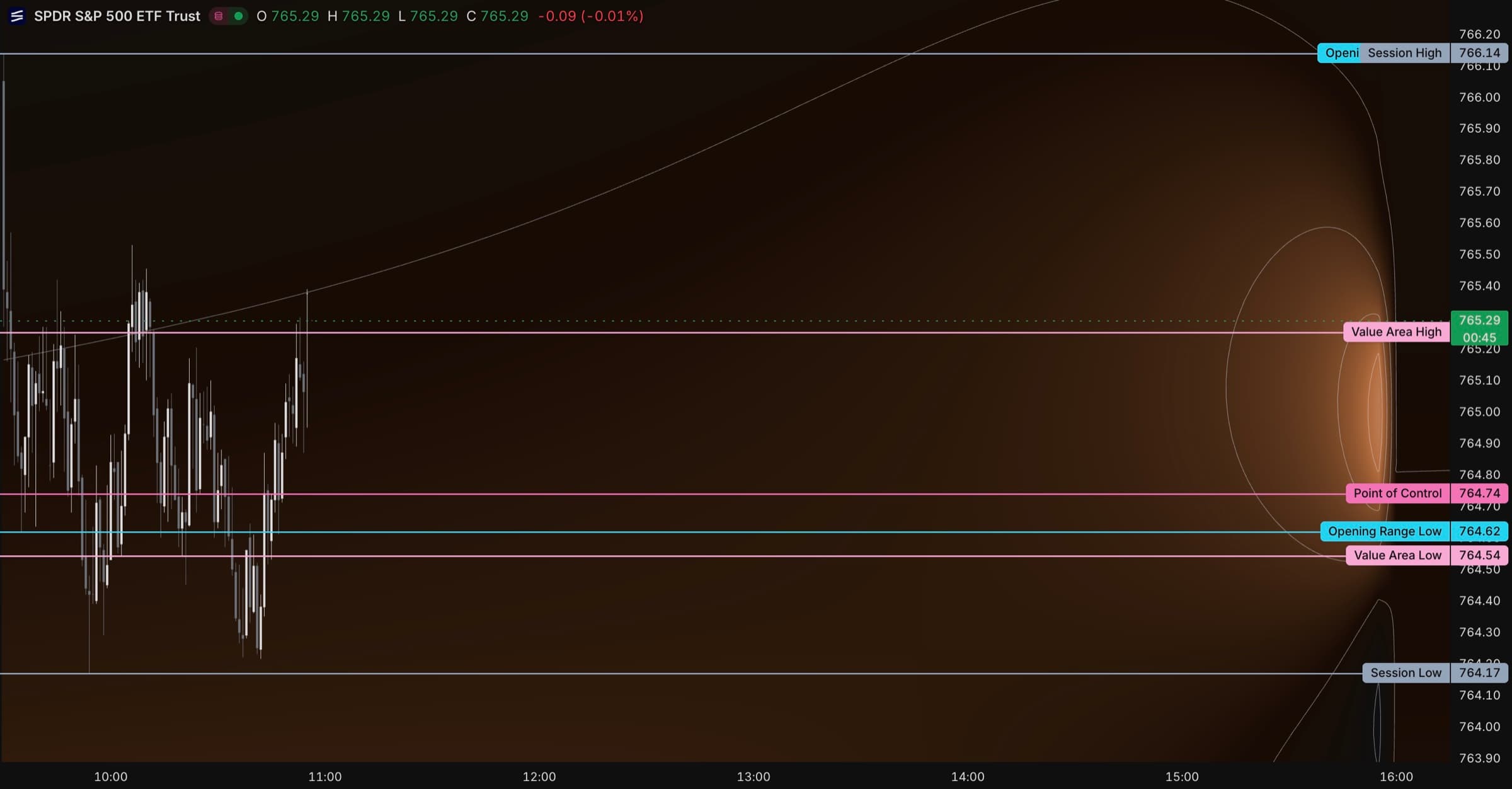
On 0DTE SPX, charm is a daily event, not a monthly one. Every session's options expire, so every afternoon carries a charm flow into the close. When positive CHEX concentrates at a strike near spot, the last hour pins; when it does not, the last hour is free to run. Read it by 2:00 ET to know which close you are trading.
Options Expiration (OpEx) Effects
Monthly and quarterly OPEX stack enormous charm at a few strikes, producing the strongest pins of the cycle. And the morning after, that charm is gone, so the pin discipline vanishes and the tape can move freely again. Re-read after every expiration.
The Clock Plus the Levels
Charm exposure tells you what the day does into the close, but it needs a target. That is what gamma is for. Overlay the Call Wall and Put Wall from gamma exposure and the lean from delta exposure to know which strike the charm pin is walking toward.
Positive CHEX at a high-gamma strike near spot is a high-confidence close pin. Negative CHEX with a thin book below is a late-day slide with nothing to catch it. The clock times the move; the walls give it a destination.
Trading It on Zero-DTE
Charm owns the last hour. On 0DTE it is the dominant flow into the close, so a pin read from the charm profile is your highest-edge late-day setup: sell premium into the strike, fade the extremes.
But respect the flip. If the book is short gamma, charm accelerates rather than pins, and a late slide can run further than any pin trade expects. Size for which regime you are in, and use defined- risk structures rather than naked shorts into the bell.
Pair it with the real-time flow. CHEX is the positioning snapshot; the live dealer hedge into the close is what Heat plots minute by minute.
Where CHEX Gets It Wrong
CHEX rests on the same flow assumption as the rest of the toolkit: customers net buy options, dealers take the other side. It holds for SPX, SPY, QQQ, and the big names in a normal tape, and it breaks when a real catalyst overwhelms the clock. A charm pin is a fair-weather force: news, a Fed headline, or a large directional sweep will run straight through it. Charm sets the tendency, not a guarantee.
Thin Names and Stale OI
On low-priced or illiquid names, a couple of stale strikes can fake a pin that no dealer is actually hedging. Expo filters strikes without a live bid and ask; rougher tools do not, which is where phantom pins come from. Treat sub-$20 names with suspicion.