
Vanna Exposure (VEX): When Volatility Moves the Tape
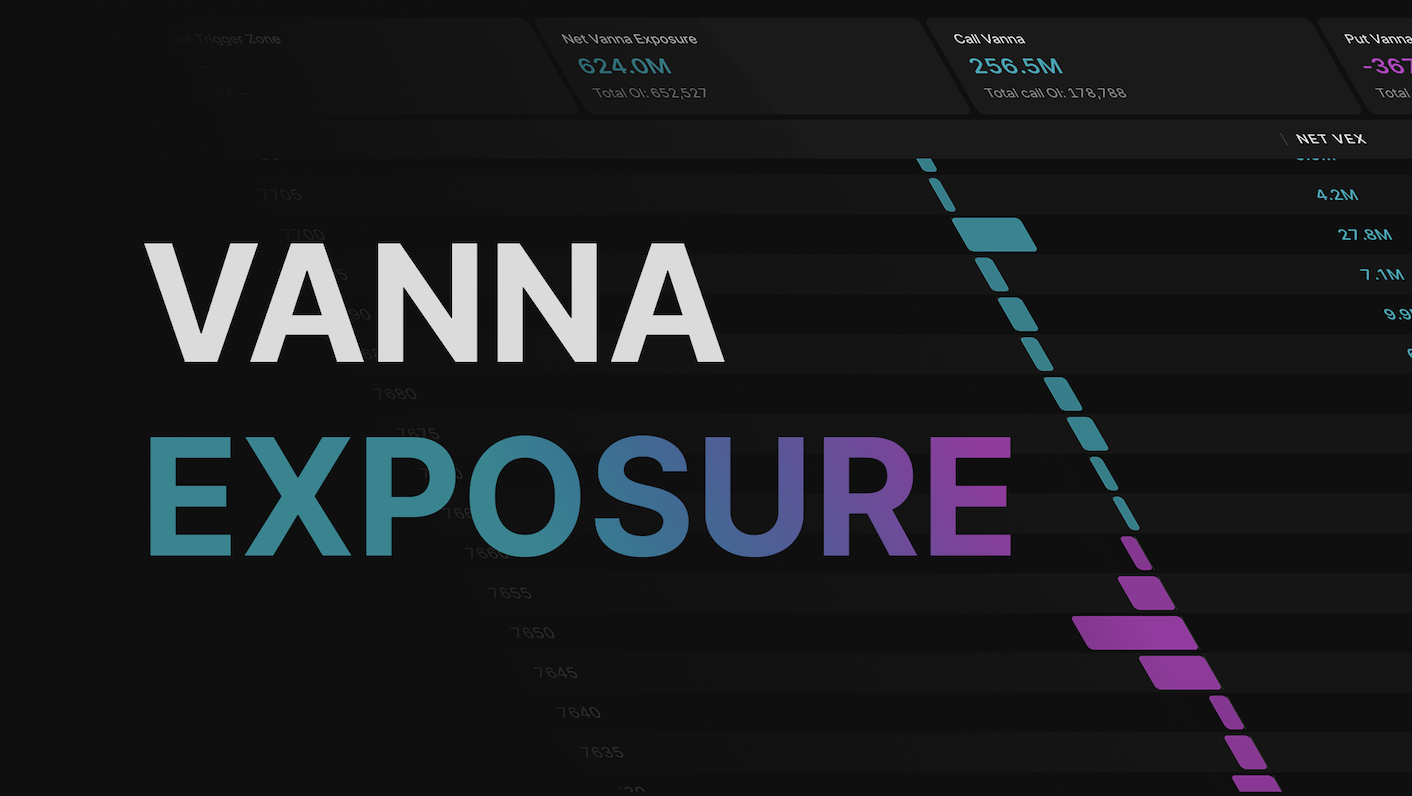
Every trader watches spot. Fewer watch the thing that quietly moves spot when nothing else is: implied vol. Vanna is the link between the two, the greek that says how much a dealer's directional hedge shifts when vol ticks up or down. When VIX drops after an event, dealers are forced to buy the underlying even though no fresh news hit. Aggregate that across the chain and you get vanna exposure, the reason markets melt up on nothing more than falling vol.
Defining Vanna and Why It Matters
Vanna measures how an option's delta changes when implied volatility changes. It is a mixed second-order greek, and it cuts both ways: the sensitivity of delta to vol is the same number as the sensitivity of vega to spot. In plain terms, vanna is the bridge between the vol surface and the directional hedge a dealer has to carry.
is delta, is implied vol, is vega, is spot. The key move: when vol shifts, every option's delta shifts with it, so the dealer's hedge is suddenly wrong and he has to re-trade the underlying to fix it. That re-hedge is a directional flow triggered by vol, not by price.
Where Vanna Lives on the Chain
Vanna is largest on out-of-the-money options, and it is especially heavy on out-of-the-money puts, which is where index skew concentrates. At-the-money vanna is near zero because a 50-delta option's delta barely reacts to a vol change. Deep in the money it fades too.
Because index books are dominated by downside puts, the vanna in SPX leans one way, and that structural tilt is what makes vanna flows so directional and so repeatable.
Reading It as a Vol-to-Price Bridge
Picture a dealer short a pile of OTM puts to a hedging crowd. Vol spikes and those puts gain delta, so the dealer is suddenly shorter than he wants and sells stock to catch up, adding fuel to the drop. Vol collapses and those same puts lose delta, so the dealer buys stock back, lifting the tape. No new directional news changed hands. Vol did.
That is vanna: a standing instruction to buy when vol falls and sell when vol rises, sized by how much OTM exposure the book carries.
Vol Down Lifts, Vol Up Presses
In the typical put-heavy index book, falling vol produces dealer buying and a grind higher, while rising vol produces dealer selling and an accelerated drop. Vanna is why calm begets rallies and fear begets air pockets.
What Is Vanna Exposure (VEX)?
VEX takes every contract's vanna, weights it by open interest, scales it to dollars, signs it by dealer positioning, and sums the chain:
is per-contract vanna at strike , is open interest, is spot. The sum tells you how much directional hedging a one-point move in implied vol will unleash, and which way it points. It is the market's sensitivity to its own fear gauge, priced as a spot flow.
Why the Whole Market Is the Edge
One book's vanna is nothing. The aggregate is a force. When market-wide VEX is large and the vol surface is stretched, a routine vol crush after a data print can move SPX more than the print itself, purely through dealer re-hedging. Reading it across the chain, which is what Expo is built for, is how you see a vanna rally coming instead of calling it a mystery melt-up after the fact.
The Punchline: VEX Is the Vol Trigger
Large VEX plus falling vol equals dealer buying and an upward grind. Large VEX plus rising vol equals dealer selling and a faster drop.
GEX gives levels, DEX gives the lean, CHEX gives the clock, and VEX gives the vol trigger that can override all three when the surface moves.
Vanna Across the Strikes
Out-of-the-money strikes carry the most vanna, and OTM puts carry the most of all in an index because that is where hedging demand and skew live. That is where a vol move does the most to dealer deltas.
At-the-money vanna is near zero: a 50-delta option is already a coin flip, so a vol change barely moves its delta. Deep in the money it fades as delta pins to ±1.
The upshot is that VEX is a downside-skew story in SPX, which is why its flows are so one-sided and so worth reading.
Vanna and Time to Expiration
Vanna is a longer-dated animal than charm or gamma. It is largest in the weeks-to-months part of the curve, where there is enough time value for a vol change to matter, so the big vanna flows come from the standing monthly and quarterly hedging book, not from 0DTE.
That said, 0DTE still feels it. When a morning vol crush fires the longer-dated vanna bid, the resulting grind is the tape that same-day traders are scalping. You may not trade the vanna directly, but you are trading the drift it creates. Know when it is on.
How Dealers Get Trapped Into Moving the Market
They take the other side, inheriting a book whose delta depends on the vol surface, not just on price.
They have to stay neutral. When vol moves, every delta in the book moves with it, and risk limits force the dealer to re-hedge in the underlying immediately.
That re-hedge is a vol-triggered spot flow. Because the whole complex carries the same skewed book and re-hedges the same vol move at once, the aggregate is a real directional force. VEX is the read on its size and direction.
Why This Matters
A market that melts up on an in-line data point looks irrational until you know vanna is behind it. A VEX-aware trader expected the grind, bought the vol crush instead of fading the rally, and stood aside when vol was rising into heavy exposure. The candle is the result. The vol move plus the dealer book is the cause. VEX is the read on both.
How This Shows Up in the Wild
The Post-Event Vanna Rally
The most reliable vanna pattern in the index: vol gets bid into a known event, the event clears without a shock, vol collapses, and the vanna bid grinds the tape up for a day or more. Fed days, CPI, and big earnings all produce it.
Vol Cascades on the Downside
The mirror is uglier. A selloff that spikes vol fires dealer selling through vanna, which deepens the selloff, which spikes vol further. The February-style air pockets are partly a vanna loop, and reading VEX before the tape cracks tells you how much fuel is sitting under a break.
Options Expiration (OpEx) Effects
Vanna and charm flows concentrate into monthly OPEX, and the well-documented post-OPEX drift is partly vanna unwinding as the hedged book rolls off. Re-read VEX after the cycle clears.
The Vol Trigger Plus the Levels
VEX tells you the vol-driven flow, but it needs price context. Overlay the Call Wall and Put Wall from gamma exposure and the standing lean from delta exposure to see where a vanna grind runs into resistance or where a vanna slide finds nothing to catch it.
A vanna bid firing under positive DEX toward a distant Call Wall is a clean long. A vanna slide into a thin Put Wall while vol is rising is a setup to stand well aside. Vol times levels.
Trading It on Zero-DTE
You will rarely trade vanna on a 0DTE option directly, because the big vanna lives further out on the curve. What you trade is the drift it creates: on a vol-crush morning, the vanna bid is the tape your same-day longs are riding.
So use VEX as a bias filter for 0DTE. Vol falling into heavy VEX favors buying dips and holding longs; vol rising into heavy VEX favors caution and downside. Pair it with defined-risk structures rather than fighting the drift.
Watch the trigger in real time. VEX is the standing exposure; the actual re-hedge as vol moves shows up live in the dealer flow that Heat plots.
Where VEX Gets It Wrong
VEX rests on two assumptions: the usual dealer-inverse flow, and a stable, skewed vol surface. It holds for SPX, SPY, QQQ, and the big names in normal conditions. It breaks when the surface moves in ways the model does not expect, like a vol-of-vol spike or a skew that snaps, and when a genuine directional catalyst swamps the re-hedge. Vanna sets the tendency; a real shock overrides it.
Thin Names and Stale Surfaces
On illiquid names, a poorly sampled vol surface produces vanna numbers that do not reflect any real hedging. Expo filters strikes without a live bid and ask, but treat single-name VEX with more caution than index VEX, where the surface is deep and clean.