
What Is Delta? How Options Respond to Price Changes

TL;DR
- Delta estimates how much an option price changes for a $1 move in the stock.
- A purchased call usually has positive Delta. A purchased put usually has negative Delta.
- Delta changes as the stock moves.
What Does Delta Measure?
Imagine your option is quoted at $4. You want to know what a small move in the stock could do to that quote. Delta gives you a starting estimate. A Delta of 0.40 means the option’s theoretical price rises about $0.40 per share for a $1 rise in the stock, with other inputs held fixed.
The key is to keep two prices separate. The stock might be quoted at $100 while the option is quoted at $4 per share. Delta describes how a change in the first quote affects the second, in the model. It gives you a way to connect the two before looking at the whole contract.
Why Do Calls and Puts Have Different Signs?
A higher stock price generally helps a call because the right to buy at a fixed strike becomes more valuable. The same move generally hurts a put because its right to sell at a fixed strike becomes less valuable. The sign flips if you’re short the option.
This is where share equivalents come from. A 0.40 Delta on a 100-share contract gives you roughly the same immediate stock-price sensitivity as holding 40 shares. The option still has its own price, expiration, and other sensitivities. The comparison applies to a small stock move at the starting point.
What Happens If the Stock Rises $1?
Say your call has a 0.40 Delta and your put has a −0.35 Delta. For a $1 rise in the stock, the call gains about $0.40 per share and the put loses about $0.35 per share, all else equal. For one standard contract each, that’s about +$40 and −$35 respectively.
These are local estimates. Over a larger move, Delta itself can change enough that multiplying your starting Delta by the whole move gives a poor estimate.
If that $4 call has 0.40 Delta, a $1 stock rise points to an estimated option quote of $4.40 per share. That’s $440 for a standard contract compared with $400 before the move. If the actual quote is different, time, IV, and changes in Delta itself are among the reasons the first estimate can miss.
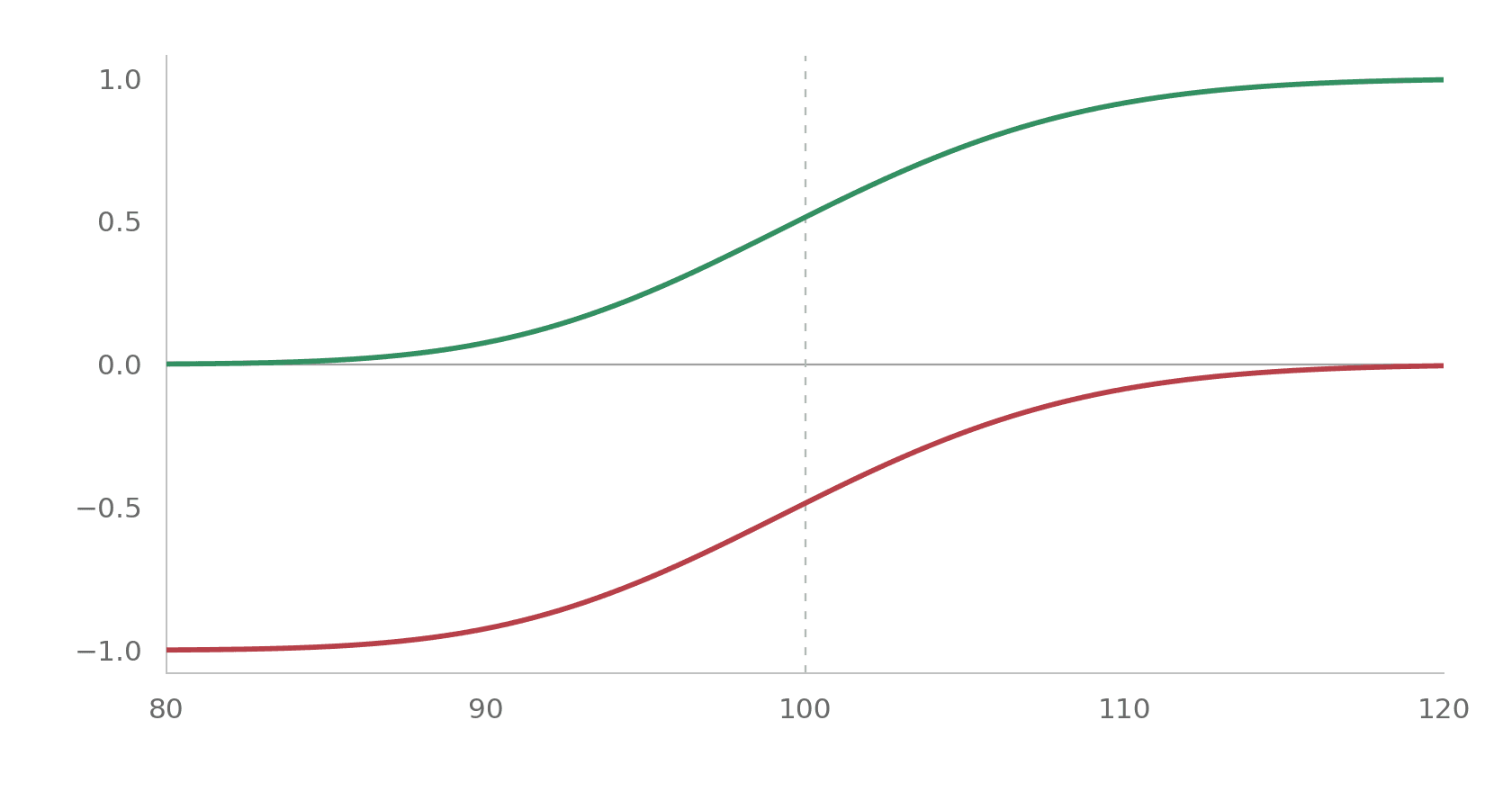
Horizontal axis is stock price in dollars. Vertical axis is Delta per option share. Emerald is the long call and mint the long put. European options, strike $100, 30 calendar days remaining, annualized IV 25%, zero rates and dividends. Dashed line marks the strike.
What to Remember
Read Delta as a price sensitivity. Next, Gamma explains why today’s Delta may look different after the stock moves.