
What Is Charm? How Delta Changes with Time

TL;DR
Can Delta Move Without a Stock Move?
You check a call’s Delta today and check it again tomorrow. The stock hasn’t moved. Implied volatility hasn’t moved either. Yet the Delta can change because the option is one day closer to expiration. Charm measures that sensitivity to time.
The distinction matters if you use Delta to describe stock exposure. Suppose a call’s Delta falls even though the stock stays flat. The option then responds a little less to the next small stock move. The sensitivity changed because the clock moved.
Why Does the Time Convention Matter?
One model may define Charm with respect to calendar time moving forward. Another may define it with respect to time remaining, which moves in the opposite direction. Their signs can differ for the same option.
For this example, positive Charm means Delta rises as a day passes. Keep that convention in mind when reading the numbers.
Look at the labels before comparing numbers. A negative value per elapsed day and a positive value per day of time remaining can describe the same direction of change. The two clocks move opposite ways. Compare the estimates after converting them to one convention.
Same Stock Price, One Day Later
Say a call has Delta 0.30 and estimated Charm of −0.02 Delta per elapsed day. Hold stock price, implied volatility, and other inputs fixed. One day later, estimated Delta is 0.28. The call now has slightly less sensitivity to the next small stock move.
That number is a local estimate. Another strike or expiration can have different Charm, including a different sign.
On a standard 100-share contract, the Delta change from 0.30 to 0.28 takes the local exposure from about 30 to 28 share equivalents. That’s a change of two share equivalents. It does not say the option lost $2 in value from time passing. That separate question belongs to Theta.
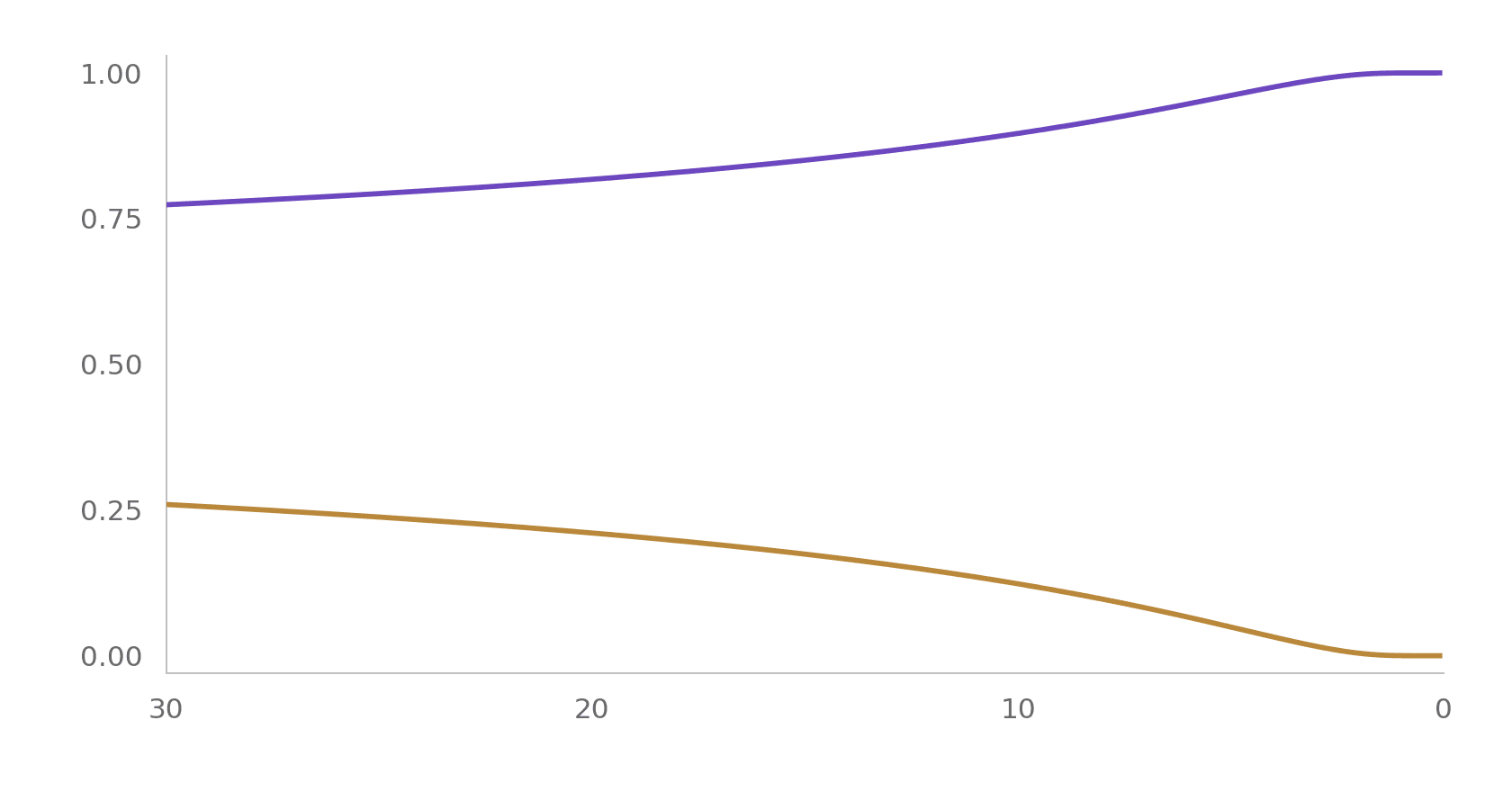
Horizontal axis is calendar days remaining, decreasing from left to right. Vertical axis is call Delta. Stock stays $100. Violet uses a $95 strike and lilac $105. Annualized IV stays 25%, rates and dividends are zero, and options are European. The curves show Delta changing as time passes. Charm measures that rate, using an elapsed-time sign convention.
What to Remember
Theta asks how time changes the option’s price. Charm asks how time changes Delta. When someone reports Charm, look for both the direction of the clock and the time unit.