
Calls and Puts: Options Basics Explained
TL;DR
- Calls give you the right to buy a stock at a specific price. They're generally used when you expect the stock to go up.
- Puts give you the right to sell a stock at a specific price. They're generally used when you expect the stock to go down.
- The catch? Options have an expiration date and cost money. You can predict the direction correctly and still lose money.
What Are Calls and Puts?
Ever wanted to make money from a stock going up or down without actually owning the shares? Well, that's where options come in.
Options are contracts that let you gain exposure to a stock's price movements without having to buy the shares outright. Sounds a little weird, right? But it's actually pretty simple once you break it down.
There are two main types of options: calls and puts.
A call option gives you the right, but not the obligation, to buy a stock at a specific price. You'd typically buy a call if you expect the stock to rise. Think of it as a way to benefit from a stock going up.
A put option is the opposite. It gives you the right, but not the obligation, to sell a stock at a specific price. You'd typically buy a put if you expect the stock to fall.
Simple enough, right? Calls for up, puts for down. At least when we're talking about buying options to speculate on direction.
But there's a little more to it.
What Does an Options Contract Actually Give You?
As mentioned above, an options contract gives you the right to buy or sell a stock at a predetermined price.
The interesting part? A standard U.S. stock option contract typically represents 100 shares. That means you can get exposure to the price movements of 100 shares without paying the full cost of owning them.
Of course, there's a catch. The market isn't handing out free money.
Every option has three important components:
- Strike price: The price at which you have the right to buy or sell the stock.
- Expiration date: The date your option expires.
- Premium: The amount you pay to purchase the option.
Now here's where options get interesting.
Even if the stock moves in the direction you predicted, you can still lose money.
Why? Because an option's value doesn't just depend on the stock price. Time remaining until expiration and expected volatility also play important roles.
These sensitivities are measured using something called the Greeks, which we'll explore in later articles.
A Simple Call and Put Example
Let's say a stock is currently trading at $100.
You think it's about to make a big move, but you're not sure which direction. Let's look at what happens if you buy a call versus a put.
For simplicity, assume both options have:
- Stock price: $100
- Strike price: $100
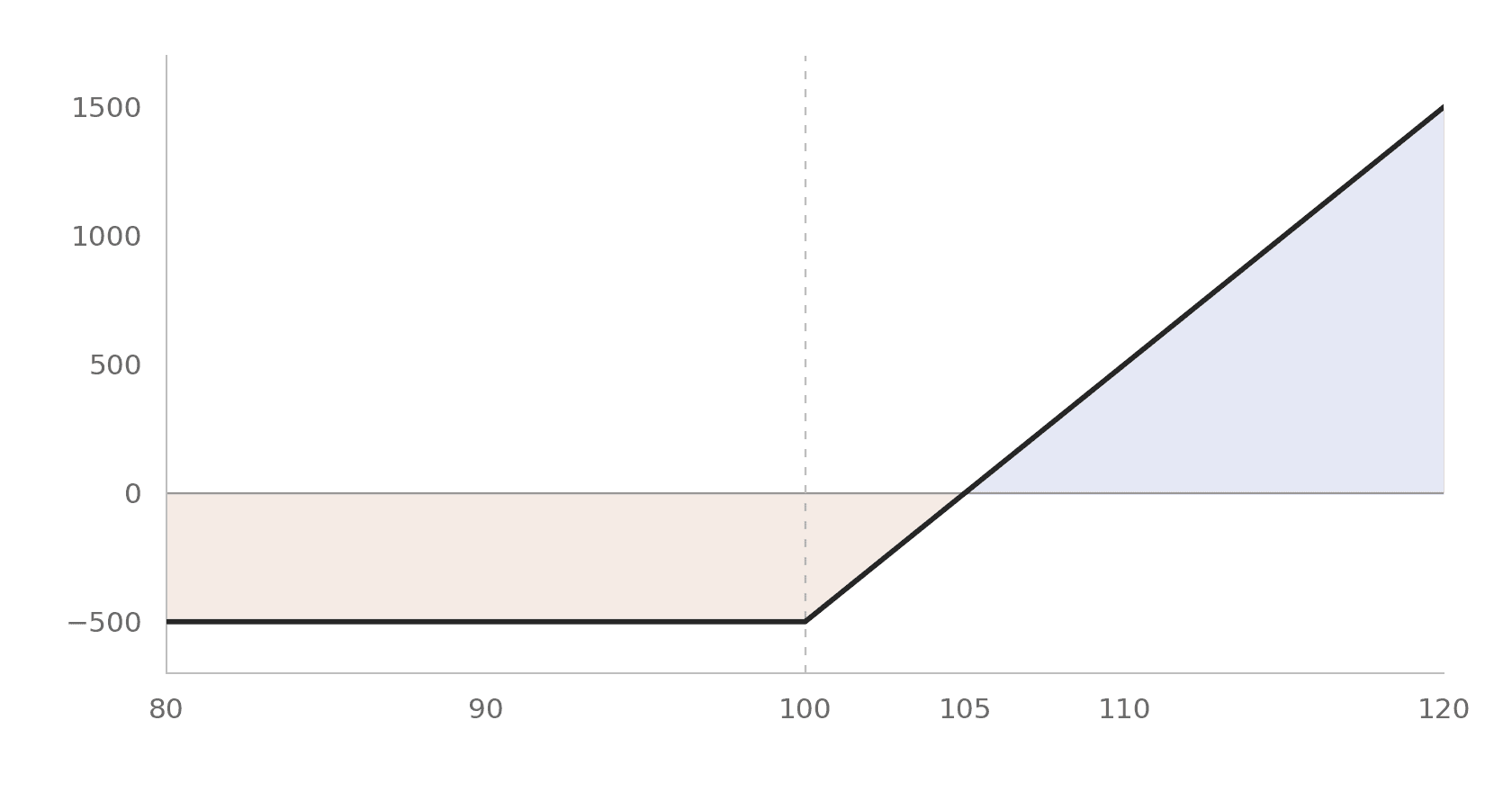
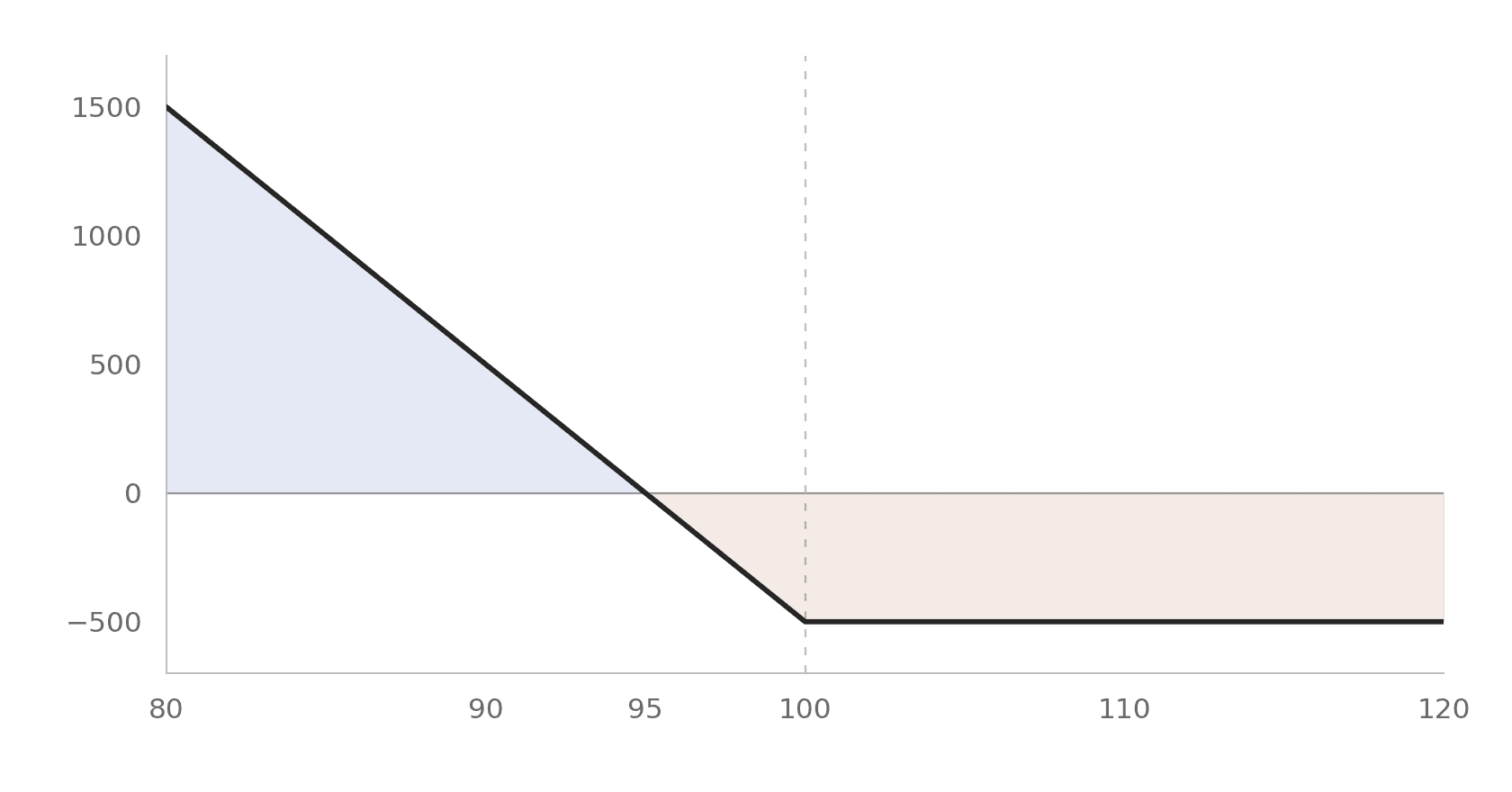
- Premium: $5 per share ($500 per contract)
- Expiration: 30 days
Scenario 1: You buy a call.
You're expecting the stock to rise. Your call gives you the right to buy 100 shares at $100 each.
If the stock reaches $120 at expiration, your right to buy shares at $100 is worth $20 per share.
That's $2,000 in value. Subtract the $500 premium you paid, and you've made $1,500 in profit, before fees.
Not bad.
Scenario 2: You buy a put.
This time, you're expecting the stock to fall. Your put gives you the right to sell 100 shares at $100 each.
If the stock drops to $80 at expiration, your right to sell shares at $100 is worth $20 per share.
Again, that's $2,000 in value. After subtracting your $500 premium, you've made $1,500 in profit, before fees.
Here's how the outcomes compare:
| Stock price at expiration | Call profit/loss | Put profit/loss |
|---|---|---|
| $120 | +$1,500 | -$500 |
| $103 | -$200 | -$500 |
| $100 | -$500 | -$500 |
| $80 | -$500 | +$1,500 |
Notice something strange?
At $103, the stock went up, exactly as the call buyer expected. Yet the call still lost $200.
That's because the stock didn't rise enough to recover the $500 premium.
For this example, the call needs the stock above $105 at expiration to make a profit. The put needs it below $95.
And no, you don't necessarily need to buy or sell 100 shares to realize a gain. You can generally sell your option contract before expiration instead of exercising it.
What Should You Remember?
Calls and puts give you two different ways to gain exposure to a stock's price movements.
Calls generally benefit from rising stock prices, while puts generally benefit from falling prices. But unlike owning shares, options have an expiration date and a premium you need to recover before making a profit.
The biggest mistake beginners make? Assuming that getting the direction right automatically means making money.
With options, direction matters. But so do timing and price.
Now that you understand the basics, the next step is learning what strike prices actually mean and why an option can be in the money, at the money, or out of the money.